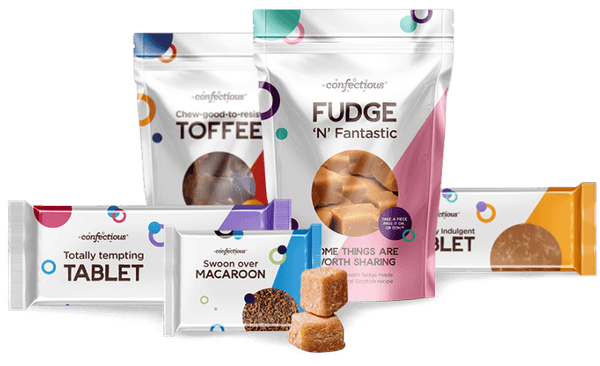
Scotland punches well above its weight when it comes to confectionery. For a small country, we've produced an astonishing range of traditional sweets — many of which are completely unique to Scotland and virtually unknown elsewhere. From the crumbly perfection of tablet to the coconut-crusted mystery of the macaroon bar, Scottish confectionery is a world of its own.
This guide covers the major players in the Scottish sweet tradition: what they are, where they came from, and why they matter.
Scottish Tablet
Tablet is arguably Scotland's most iconic confection. It's a firm, crumbly sweet made from sugar, butter, and condensed milk, boiled to a high temperature and beaten until it sets with a distinctive fine-grained texture. The flavour is intensely buttery and caramelised.
The first known recipe dates to 1718, making tablet one of Scotland's oldest documented sweet recipes. Today, it remains a staple at weddings, Burns Night suppers, and Highland games across the country. Every Scottish family seems to have their own recipe — or at least an opinion on whose granny made the best.
Tablet differs from fudge primarily in texture: it's firmer, crumblier, and has that characteristic grain, whereas fudge is soft and smooth. For a deeper dive, read our complete tablet vs fudge comparison.
Try our handmade Scottish tablet →
Scottish Fudge
Scottish fudge follows the broader British and American fudge tradition but has its own character. Made from sugar, butter, cream, and milk, Scottish fudge tends to be rich, buttery, and intensely creamy. Many Scottish fudge makers — including us — use traditional slow-cooking methods and high-quality flavourings like real vanilla pods rather than extract.
While fudge doesn't have quite the same ancient pedigree as tablet in Scotland, it's become every bit as beloved. The two are often sold side by side, and many confectioners make both. The key difference is in the cooking temperature and method: fudge is cooked at a lower temperature and stirred gently to achieve a smooth, non-crystalline texture.
Try our handmade Scottish fudge →
Scottish Macaroon Bars
The Scottish macaroon bar is one of the most distinctive — and most frequently misunderstood — confections in the country. It has nothing to do with French macarons. Instead, it's a bar of sweet fondant, coated in dark chocolate, and rolled in toasted desiccated coconut.
Traditionally, the fondant was made with mashed potato mixed with icing sugar — a thrifty, clever technique that produces a dense, smooth filling without the complexity of boiled sugar fondant. The macaroon bar is generally credited to John Justice Lees, who reportedly invented it in 1931.
For the full story, see our complete guide to Scottish macaroon.
Try our handmade Scottish macaroon →
Coconut Snowballs
Snowballs are a delicate, light confection traditionally associated with Scotland's Italian cafe culture. They consist of a soft, marshmallowy centre enrobed in chocolate and rolled in desiccated coconut — hence the name. They're lighter and more delicate than macaroon bars, with a softer centre.
Snowballs have deep roots in the Italian-Scottish cafe tradition that flourished from the late 19th century onwards, when Italian immigrants established ice cream parlours and cafes across central Scotland. Many of these cafes served snowballs alongside ice cream, and they remain a nostalgic favourite.
Edinburgh Rock
Edinburgh rock is a sugar confection quite unlike any other type of rock candy. It has a soft, crumbly, powdery texture — almost chalky — that dissolves gently on the tongue. It comes in pastel colours and mild flavours (vanilla, lemon, ginger, rose). It was invented by Alexander Ferguson, known as "Sweetie Sandy," in the early 19th century, apparently by accident when he left a batch of traditional rock candy in a damp cupboard and discovered the resulting texture was rather pleasant.
Edinburgh rock is still widely sold in tins as a tourist souvenir, though it's enjoyed by Scots as much as visitors.
Butterscotch and Toffee
Scotland has a strong tradition of butterscotch and toffee making, with many regional variations. Scottish butterscotch tends to be hard and clear with a deep butter flavour, while Scottish toffees range from hard boiled varieties to softer, chewier styles. Buchanan's of Glasgow and various regional makers have kept this tradition alive.
Puff Candy (Honeycomb)
Puff candy — known elsewhere as honeycomb, cinder toffee, or hokey pokey — is a light, aerated sugar confection made by adding bicarbonate of soda to boiling sugar syrup. The chemical reaction creates thousands of tiny bubbles, giving it that distinctive crunchy, sponge-like texture. In Scotland, it's traditionally called puff candy and has been a staple of sweet shops and ice cream parlours for generations.
Scottish Confectionery and the Italian Connection
One of the most fascinating aspects of Scottish confectionery history is the Italian influence. From the 1880s onwards, waves of Italian immigrants settled in Scotland — particularly in Glasgow, Edinburgh, and the west coast towns — and established ice cream parlours and cafes. These Italian-Scottish families didn't just bring gelato; they became integral to Scotland's sweet-making tradition.
Many of Scotland's most beloved confectionery businesses were founded by Italian-Scottish families, and the cafe culture they created became the primary setting where Scots enjoyed sweets like snowballs, nougat wafers, and ice cream with tablet. This cultural fusion is one of the unique strengths of Scottish confectionery.
The Craft Revival
In recent years, there's been a strong revival in artisan Scottish confectionery. Small-batch makers are returning to traditional recipes, using quality ingredients, and focusing on the handmade craft that made these sweets special in the first place. The Great Taste Awards regularly recognise Scottish confectioners, and there's a growing appetite — both in Scotland and beyond — for the real thing rather than mass-produced imitations.
At Confectious, we're proud to be part of this tradition. Our tablet, fudge, and macaroon bars are all handmade in Glasgow using family recipes, poured on traditional cooling tables, and delivered fresh to your door. We've been awarded Great Taste Awards and the Family Business Award because we believe the old ways of making sweets are worth preserving.