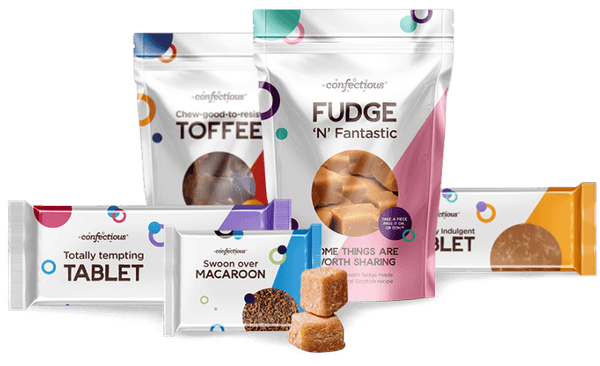
It's the question we get asked more than any other: "What's the difference between tablet and fudge?" And honestly, we don't blame anyone for being confused. They look similar, they share most of the same ingredients, and if you've only ever seen them behind a counter, you might think they're the same thing.
They're not. Not even close.
At Confectious, we make both Scottish tablet and handmade fudge every single day in our Glasgow bakery — and we can tell you the difference is night and day once you try them side by side. Here's everything you need to know.
The Quick Answer
Scottish tablet is firmer, crumblier, and has a satisfying grainy texture that melts on your tongue. Fudge is softer, smoother, and creamier. Tablet snaps when you break it; fudge bends. Tablet is boiled hotter and beaten harder; fudge is cooked lower and stirred more gently. Same family, very different personalities.
How the Ingredients Differ
The core ingredients overlap — sugar, butter, and milk are in both. But the ratios and specific dairy products create the difference.
Scottish Tablet Ingredients
- Granulated sugar (a lot of it)
- Sweetened condensed milk
- Butter
- Whole milk
Condensed milk is the key player in tablet. Its high sugar concentration and cooked milk solids are what give tablet its distinctive caramelised flavour and that characteristic crumble.
Scottish Fudge Ingredients
- Sugar
- Butter (typically a higher ratio than tablet)
- Cream or evaporated milk
- Vanilla or other flavourings
Fudge relies more on cream and butter for its richness. Our Fudge n Fantastic uses AAA organic Madagascan vanilla pods — it's those richer dairy fats that give fudge its smooth, creamy mouthfeel.
The Texture Difference
This is where most people notice the distinction immediately.
Scottish tablet has a firm, slightly crumbly texture with a fine grain. When you bite into a piece, it initially resists, then dissolves on your tongue in a rush of buttery sweetness. Some people describe it as "sandy" in the best possible way — those tiny sugar crystals are the hallmark of well-made tablet. It should snap cleanly when you break a piece off.
Scottish fudge is soft, dense, and smooth. It yields when you bite into it and has a chewier, more yielding quality. Good fudge should feel almost creamy in your mouth with no graininess at all. It bends rather than snaps.
Think of it this way: tablet crumbles, fudge squishes.
How They're Made Differently
The cooking method is where the real divergence happens, and it's fascinating if you're into the food science of it.
Making Tablet
Tablet is boiled to a higher temperature — around 118°C (244°F), known as the "firm ball" stage in sugar work. After reaching temperature, the mixture is beaten vigorously. This beating is crucial: it encourages the formation of many small sugar crystals, which is what gives tablet its signature grainy-yet-melt-in-the-mouth texture. The more you beat, the finer and more uniform those crystals become.
In our factory, we pour the hot mixture onto traditional cast-iron cooling tables — a method that's been used for generations. We think its the right way to do things.
Making Fudge
Fudge is cooked to a slightly lower temperature — typically around 114–116°C (237–241°F), the "soft ball" stage. It's then cooled more gradually and stirred gently rather than beaten aggressively. The goal is to create very few, very small sugar crystals — or ideally none that you can detect. This is what produces that smooth, creamy texture.
Our fudge is slow-cooked for longer at a lower temperature to develop those rich caramel undertones without the crystalline structure of tablet.
The Flavour Difference
Scottish tablet tastes intensely of caramelised sugar and butter. The condensed milk gives it a distinctive cooked-milk sweetness that's hard to describe until you've tried it — it's richer and more complex than plain sugar. There's a reason Scots get misty-eyed about it; the flavour is deeply nostalgic and unlike anything else.
Scottish fudge has a more rounded, buttery-creamy flavour. Because it typically uses cream rather than condensed milk, the taste is smoother and more "dairy-forward." It's also a more versatile base for added flavours — vanilla, chocolate, sea salt, whisky — because the softer flavour profile lets those additions shine through.
A Brief History
Scottish tablet has the longer pedigree. The first known written recipe appeared in 1718, though it was likely being made well before that. Early versions used sugar and cream, boiled together — condensed milk came into the picture in the late 19th century when tinned milk became widely available.
Fudge has murkier origins. It's generally believed to have emerged in America in the late 1800s — possibly from a "fudged" batch of caramels — before crossing the Atlantic and becoming popular across the UK. Scottish fudge took on its own character, influenced by the same butter-and-dairy traditions that gave us tablet.
They're cousins, essentially. Same lineage, different paths.
Which Should You Choose?
Honestly? Both. But if you're deciding:
- Choose tablet if: you love intense sweetness, satisfying crumble, and that unmistakable caramelised flavour. Tablet is the purist's choice — it's unapologetically Scottish and unapologetically sweet.
- Choose fudge if: you prefer something softer, creamier, and a bit more subtle. Fudge is also the better choice if you're looking for flavour variety.
- Choose both if: you want the full Scottish confectionery experience. Our Pick Your Own Selection Boxes let you mix tablet, fudge, and macaroon bars so you can try them all.
Try Them Side by Side
The best way to understand the difference is to taste them together. We make both fresh every day in Glasgow:
- Scottish Tablet — our award-winning Totally Tempting and Irresistibly Indulgent recipes
- Scottish Fudge — slow-cooked with organic Madagascan vanilla
- Selection Boxes — mix and match to compare
All come with free UK delivery and are made fresh to order. Or subscribe and save 10% to get a regular delivery through your letterbox.