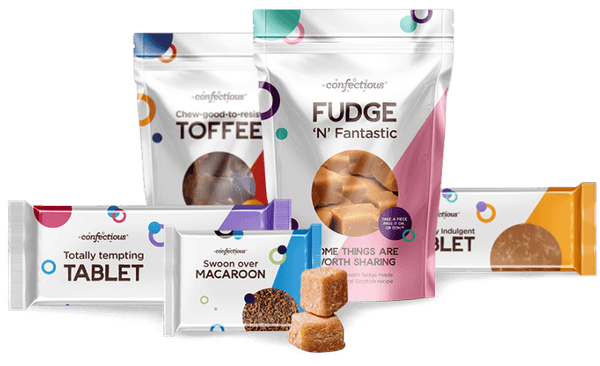
Scottish tablet is one of Scotland's most beloved confections — a golden-brown, crumbly, melt-in-your-mouth sweet that's been handed down through generations. If you've ever tried it, you know there's nothing quite like it. And if you haven't? You're in for a treat.
At Confectious, we've been making tablet by hand in Glasgow for decades, using recipes passed down through the family. We pour thousands of batches a year on our traditional cast-iron cooling tables. So when it comes to getting tablet right, we know a thing or two.
This guide covers everything: the traditional recipe, tips from our factory floor, the science of why tablet goes wrong (and how to fix it), and a few secrets we've picked up over the years.
What is Scottish Tablet?
Scottish tablet is a traditional confection made from sugar, butter, and condensed milk. It's often compared to fudge, but it's quite different — tablet has a firmer, more crumbly texture with a slight grain, whereas fudge is soft and smooth. The flavour is intensely buttery and caramelised, with that distinctive sweetness that hits you the moment it melts on your tongue.
Tablet has been part of Scottish food culture for centuries. The earliest known recipe dates back to 1718 in The Household Book of Lady Grisell Baillie, where it was listed as a sugar and cream mixture. Over time, the recipe evolved — condensed milk became the standard ingredient when Nestlé's tins became widely available in the early 20th century — but the principle remains the same: boil sugar and dairy together until it reaches the right temperature, then beat it until it sets with that perfect crumble.
You'll find tablet at weddings, Burns Night suppers, Highland games, and on tea trays in hotels across Scotland. It's as much a part of Scottish identity as shortbread or haggis.
Traditional Scottish Tablet Recipe
This is the classic recipe — the one your gran probably used, and the one closest to what we make at Confectious (though we'll never reveal all our secrets). It makes roughly 40–50 pieces.
Ingredients
- 1kg granulated sugar
- 250ml whole milk
- 125g salted butter
- 1 tin (397g) sweetened condensed milk
- A splash of vanilla extract (optional)
Equipment You'll Need
- A large, heavy-bottomed saucepan (at least 5 litres — the mixture rises significantly)
- A wooden spoon or silicone spatula
- A sugar thermometer (highly recommended)
- A greased or lined baking tray (roughly 20cm x 30cm)
Method
- Dissolve the base. Put the sugar, milk, and butter into your saucepan over a low heat. Stir continuously until the sugar has completely dissolved and the butter has melted. This is the most important step — if any sugar crystals remain undissolved, your tablet may end up grainy in the wrong way. Take your time; this can take 10–15 minutes.
-
Add the condensed milk. Once the mixture is smooth, pour in the condensed milk and stir to combine.
-
Bring to the boil. Turn the heat up to medium and bring the mixture to a rolling boil. Stir constantly from this point — the mixture will catch and burn on the bottom if you stop. This is the arm workout part of tablet making.
-
Boil to temperature. Keep the mixture at a steady boil for 15–20 minutes, stirring all the time. You're aiming for a temperature of 118°C (244°F) on your sugar thermometer — this is the "firm ball" stage. The mixture will darken to a rich golden-caramel colour. If you don't have a thermometer, drop a small amount into cold water — it should form a firm, pliable ball.
- Beat it. Take the pan off the heat and beat the mixture vigorously with your wooden spoon for 5–10 minutes. This is the step that transforms your liquid into tablet. You'll feel the mixture thicken and start to lose its glossy sheen. When it begins to stiffen and becomes harder to stir, you're ready.
- Pour and set. Quickly pour the mixture into your prepared tray. Don't scrape the sides of the pan — any crystallised bits on the edge will create lumps. Leave to cool for 5 minutes, then score into squares with a knife. Allow to cool completely (1–2 hours) before breaking into pieces.
Why Scottish Tablet Goes Wrong (And How to Fix It)
Tablet has a reputation for being temperamental, and that's fair. Here are the most common problems and what causes them — these are the things we've learned from making thousands of batches.
Problem: Tablet won't set
This is almost always a temperature issue. The mixture hasn't been boiled long enough to reach 118°C. If your tablet is still soft after cooling, you can return it to the pan, reheat gently, and boil for a few more minutes. A sugar thermometer really does take the guesswork out of this.
Problem: Tablet is rock hard
You've overcooked it — the temperature went too high, past the firm ball stage into hard ball or beyond. Unfortunately, there's no easy fix for this one. Next time, take it off the heat a degree or two earlier than you think you should.
Problem: Tablet is too grainy or sandy
Some grain is normal and desirable — it's what makes tablet different from fudge. But if it's unpleasantly gritty, the sugar wasn't fully dissolved at the start, or it wasn't beaten enough after cooking. Make sure you stir until every grain is dissolved before bringing to the boil.
Problem: Tablet has a burnt taste
The mixture caught on the bottom of the pan during boiling. Use a heavy-bottomed pan and stir continuously — no stepping away to check your phone. If you're using an electric hob, a heat diffuser can help prevent hot spots.
Tips From the Confectious Factory Floor
After decades of making tablet professionally, here are a few things we've learned that you won't find in most recipes:
-
The pan matters more than you think. A thin pan will give you uneven heat and burnt patches. We use heavy copper-bottomed pans and open pan boilers in the factory. At home, your thickest saucepan is your best friend.
- Don't rush the dissolving stage. We see people crank up the heat to speed things along. Don't. Low and slow at the start sets you up for success.
- The colour tells you a lot. When it turns from pale yellow to a rich golden-caramel, you're nearly there. Trust your eyes as well as the thermometer.
- Beat with purpose. The beating stage is where the magic happens. You're encouraging the right kind of sugar crystal formation. Too little beating and it won't set properly. You want to beat until you feel real resistance and the mixture starts pulling away from the sides of the pan.
- Weather affects tablet. Seriously. Humidity can affect how tablet sets. Professional confectioners know this — it's one of the reasons handmade tablet varies slightly from batch to batch. On a very humid day, you may need to boil a degree or two higher.
- Fresh is best. Tablet with no preservatives (like our Totally Tempting Tablet) is at its best within 3–5 weeks. Store it in an airtight container in a cool, dry place.
Variations to Try
Once you've mastered the basic recipe, there's plenty of room to experiment:
- Whisky tablet: Add 2–3 tablespoons of Scotch whisky during the beating stage. The alcohol mostly cooks off, leaving a warm, smoky undertone.
- Chocolate tablet: Stir in 50g of melted dark chocolate just before pouring into the tray.
- Vanilla bean tablet: Replace vanilla extract with the seeds of one vanilla pod, added at the dissolving stage.
- Salted tablet: Sprinkle flaked sea salt over the surface immediately after pouring.
- Ginger tablet: Add 2 teaspoons of ground ginger during the dissolving stage.
Scottish Tablet FAQ
Is Scottish tablet gluten free?
Yes — traditional Scottish tablet is naturally gluten free. It contains sugar, milk, butter, and condensed milk. Always check the label if buying commercially, but all Confectious tablet is gluten free.
What's the difference between Scottish tablet and fudge?
Tablet and fudge share similar ingredients but have very different textures. Tablet is boiled to a higher temperature and beaten to create a firmer, crumblier texture with a slight grain. Fudge is cooked at a lower temperature and has a softer, creamier consistency. We make both — you can try our handmade fudge here and taste the difference for yourself.
How long does Scottish tablet last?
Homemade tablet without preservatives will keep for 3–5 weeks in an airtight container. Our Irresistibly Indulgent Tablet has a longer shelf life thanks to a small amount of preservative, making it ideal if you're buying in advance or sending as a gift.
Can you freeze Scottish tablet?
Yes! Tablet freezes beautifully. Wrap individual pieces or place in a freezer bag with the air squeezed out. It'll keep for up to 3 months. Defrost at room temperature — it tastes just as good.
Why is my tablet not setting?
Almost always a temperature issue. The mixture needs to reach 118°C (244°F). If it hasn't set after cooling, return it to the pan, reheat gently, and boil for another few minutes, checking the temperature. A sugar thermometer is a worthwhile investment.
Don't Fancy Making Your Own?
We get it — tablet can be tricky, and sometimes you just want to enjoy the finished product without the arm ache. Our tablet is handmade fresh every day in Glasgow using traditional recipes, poured on cast-iron cooling tables just like it's always been done. We've won Great Taste Awards for a reason.
Browse our Scottish Tablet range →
Or if you'd like a regular supply, our subscription boxes are designed to fit through your letterbox — no faffing, no fuss, just fresh handmade tablet delivered to your door. Save 10% when you subscribe.
Love Scottish sweets? Don't miss our handmade coconut macaroons — another Glasgow favourite, baked fresh and available in sharing bags and gift boxes.